
Quick answer
The three arrangements differ in who starts the design and who ends up owning it. Under OEM the customer supplies the part definition and normally owns the drawing and the tool; under ODM the manufacturer brings an existing platform and the customer licenses or adapts it; under private label the customer owns only the brand, not the tooling. The commercial consequences sit in four clauses: mold ownership, drawing and CAD ownership, exclusivity, and what happens to the tool when the programme ends. Agree those before the first steel is cut, because after that the answer is negotiable only at the manufacturer's convenience.
Most sourcing conversations about custom injection molded parts begin with a price and a lead time, and most of the disputes that follow begin somewhere else entirely. They begin with an assumption about ownership that was never written down. A buyer assumes that paying for a mold means owning it. A manufacturer assumes that a tool built in its own workshop, to its own standard, with its own electrode set, remains its own asset unless the contract says otherwise. Both assumptions are reasonable, and they cannot both be true.
At Hangzhou Xucheng we build molds and run series production for automotive interior parts, and we have seen the ownership question arrive late in programmes that were otherwise well managed. This article sets out how the three arrangements actually differ, what a customer is really paying for when they fund a tool, which clauses decide the outcome, and how a custom tool differs from a patented one. It is written for program managers and sourcing engineers who need the answer in writing before tooling starts.
Three arrangements, three different starting points
The distinction is not about who is more capable. It is about where the part definition originates and who carries the cost of creating it.
- OEM — the customer defines the part, usually with a drawing, a CAD model and a set of performance requirements. The manufacturer builds the tool to that definition and produces to it. The customer carries the engineering risk and normally funds the tool.
- ODM — the manufacturer already has a platform: a mold, a validated process, a material and a finish. The customer selects from it, may ask for surface or colour changes, and sells it under their own brand. The tool pre-exists the customer.
- Private label — the customer buys a finished product made to the manufacturer's specification and applies branding, packaging and documentation. There is no part-level development at all.
The practical test is simple: ask who would have to pay for the mold if the programme were cancelled tomorrow. If the answer is the customer, the arrangement is OEM or a custom ODM variant. If the answer is the manufacturer, it is ODM or private label, and the customer is buying capacity and product rather than tooling.
What a customer actually pays for when they fund a mold
A mold quotation is not a single number and it does not buy a single thing. It buys a set of deliverables that should be itemised: the mold design package, the steel, the machining hours, the electrodes, the heat treatment, the trial shots, the correction loops and the documentation. In a well-written quotation each of those lines is visible, because each of them is a thing the customer can later ask to see, take away or audit.
The confusion arises because the physical object and the intellectual content are priced together. A customer who pays for a tool has paid for a block of steel and also for the design decisions embedded in it: parting line position, gate location, cooling layout, ejector plan, slide and lifter design, and the grain specification on the cavity surface. When the programme ends, the steel can be crated and shipped. The design intent travels with it only if the drawings and the CAD data travel too.
| What the customer pays for | Physical or intellectual | What should be handed over |
|---|---|---|
| Mold base and cavity steel | Physical | The tool itself, on the agreed terms |
| Mold design and 3D model | Intellectual | Native CAD files plus a neutral-format set |
| Grain and texture specification | Intellectual | The grain standard and its source reference |
| Process window and trial records | Intellectual | Trial reports, setting sheets, inspection data |
| Electrodes and fixtures | Physical | Normally retained by the toolmaker; negotiate if needed |
Mold ownership: the four clauses that decide it
Ownership is not a single sentence. It is four separate questions, and a contract that answers one of them and leaves the others open is worse than no clause at all, because it creates confidence without protection.
- Title — who owns the tool, and at what point ownership transfers: on payment, on completion of the trial, or on completion of the programme.
- Custody — who holds the tool, where it is stored, and who pays for maintenance, insurance and storage while it sits idle between orders.
- Use — whether the manufacturer may run the tool for other customers, and whether the customer has exclusivity for the part or for the market.
- Exit — the conditions under which the tool is released, who pays for the transfer, and what documentation accompanies it.
The exit clause is the one most often left vague, and it is the one that matters when a relationship ends badly. A tool released without its process sheet, its trial history and its grain reference is a tool the next molder has to re-diagnose from scratch, which typically costs several weeks and a fresh correction loop. Release terms should therefore name the documentation set, not just the steel.
Drawings, CAD data and the boundary of confidentiality
Owning a drawing is not the same as owning the right to use it. In an OEM programme the customer's drawing is the customer's intellectual property, and the manufacturer's obligation is to use it only for that customer's parts. In practice this is protected by a non-disclosure agreement, a defined list of people with access, and a rule about where the data may be stored.
The mirror question is whether the manufacturer's process knowledge belongs to the customer. It does not. A DFM report written for one part contains observations that apply to many parts, and a process window developed over years is the manufacturer's asset. A customer who asks for the process window of their part is asking for something reasonable; a customer who asks for the manufacturer's general process library is asking for something else, and the contract should distinguish the two.
What happens to the mold when the programme ends
Three outcomes are normal, and the contract should say which applies. The customer may take the tool to another molder, which is the clearest interpretation of ownership and the one that requires the fullest documentation handover. The customer may leave the tool in place and continue to order from the original manufacturer, which is common when the tool is large, heavy or expensive to move. Or the manufacturer may buy the tool back at a depreciated value, which is a commercial settlement rather than a transfer.
Whichever applies, the practical questions are the same: who pays for the last production run, how much stock remains, who owns the samples and fixtures, and whether the tool is in a condition to run. A tool that has produced two million shots is not the same asset as the one that was shipped, and a transfer clause that ignores wear will be argued about.
Patent versus custom tooling: why they are not the same
A manufacturer's patents do not transfer with a customer's tool. Our own portfolio, for example, covers a modular injection mold system, a mobile injection molding machine design and a gas-mark elimination mold technology. Those are our intellectual property, developed at our cost and applicable across many programmes. A customer's tool built using one of those technologies does not carry the patent with it, any more than a house built with a patented nail carries the nail patent.
The distinction matters at the point of transfer. A tool that embodies a patented feature may not be legally run by a third party without a licence, even if the customer owns the steel. That is a real constraint on the exit clause, and it should be discussed at the start rather than discovered at the end. Where a customer needs full portability, the tool can be designed without the proprietary feature, at some cost in cycle time or yield, and that trade should be made explicitly.
Private label without a mold: the third route
A significant share of enquiries do not need a new tool at all. If the requirement is a door handle cup, a wiring harness bracket or a side guard strip in a standard material and finish, an existing mold can often be adapted through colour, grain or minor insert changes, with no tooling investment and a lead time measured in weeks rather than months. This is the cheapest route into a market and the one most often overlooked, because the conversation usually starts with a drawing rather than with a question about what already exists.
The limitation is differentiation. A part made from an existing tool is available to anyone else who asks for it, unless exclusivity is negotiated separately. For a brand that needs a distinctive visible surface, the private label route is a way to test a market, not a way to build a defensible product. The three levels of customisation, and what each one costs in tooling and time, are set out in our companion article on that subject.
Six questions are worth answering in writing before the purchase order is issued, because each one is cheap now and expensive later: who owns the tool and when title passes; what documentation is handed over at the end; whether the tool may be used for other customers; what happens to patent-bearing features at transfer; who pays for maintenance between orders; and what the release conditions are if the relationship ends. A program manager who can answer all six has done more for the programme than a month of price negotiation, because the price is a one-time number and the ownership terms govern every order that follows.
FAQ
If we pay for the mold, do we automatically own it?
Not automatically. Payment funds the tool, but ownership is a contractual term and it has to say when title passes. Many moulding contracts place title with the customer on final payment, others on completion of the programme, and some retain title with the manufacturer while granting the customer exclusive use. All three are workable; an unwritten assumption is not.
Can we take the mold to another supplier later?
Usually yes, if the contract provides for it and the tool is in a runnable condition. The practical difficulty is not the steel but the knowledge: process settings, correction history, grain reference and inspection fixtures. A transfer clause should list the documentation that travels with the tool, otherwise the next molder will spend weeks re-establishing what the first one already knew.
Does an ODM part come with any tooling rights at all?
Normally no. In an ODM arrangement the manufacturer owns the platform and the customer buys product made on it. What the customer can negotiate is exclusivity for a market, a colour or a configuration, which is a commercial right rather than an ownership right. If the part is central to the brand, the more durable route is an OEM development where the customer funds the tool.
Who owns the DFM report and the trial data?
The report is written for the customer's part and is normally shared with them. What the manufacturer retains is the general process knowledge behind it. In practice the useful split is: the customer receives the part-specific findings, dimensions, trial results and correction records, while the manufacturer keeps its internal process library and any proprietary tooling technology.
What if the tool needs a patented feature to meet the specification?
Then the licence question has to be settled before tooling, not after. A tool that depends on a patented feature cannot be run by a third party without permission, even if the customer owns the steel. Where portability matters more than cycle time or yield, the design can usually be adapted to avoid the proprietary feature, and it is cheaper to make that trade at the design stage than at the transfer stage.
Start with the ownership terms, then the tooling
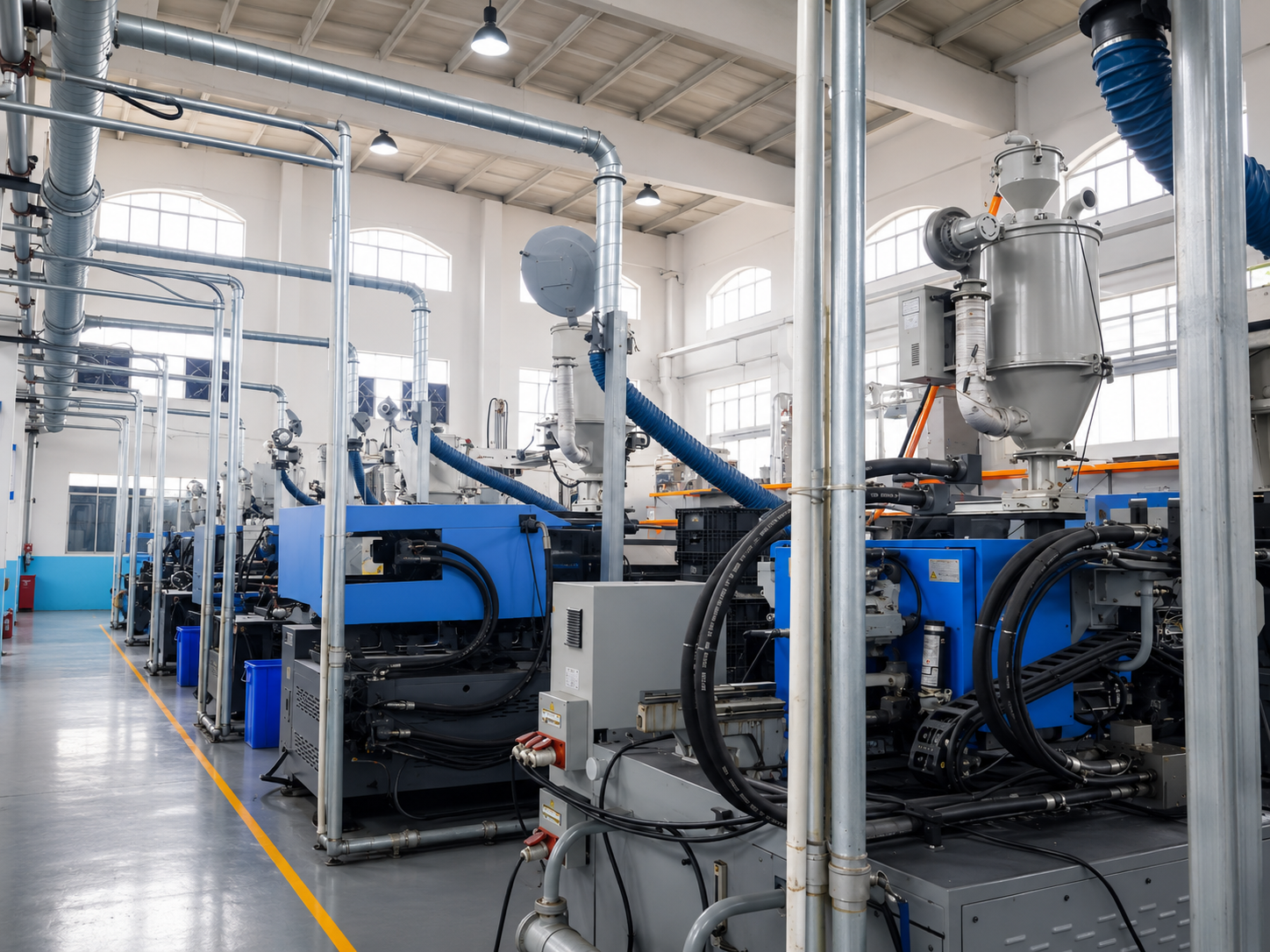
Hangzhou Xucheng Automotive Components Co., Ltd. has been manufacturing automotive interior injection molded parts since November 2016 and is certified to ISO/TS16949:2009. We run 13 injection molding machines from 200 t to 1,600 t and 15 in-house mold machining units covering CNC, EDM, precision grinding and cutting, and we hold three patents covering a modular injection mold system, a mobile injection molding machine design and a gas-mark elimination mold technology. We handle mold development, custom design, injection production and quality inspection as one sequence. Send us your part data and tell us which arrangement you intend, and we will return a tooling proposal with the ownership terms stated explicitly.